To train a good embedder or reranker, you need pairs of a question and the passage that answers it. In English these are easy to find. In most of the world's languages they barely exist.
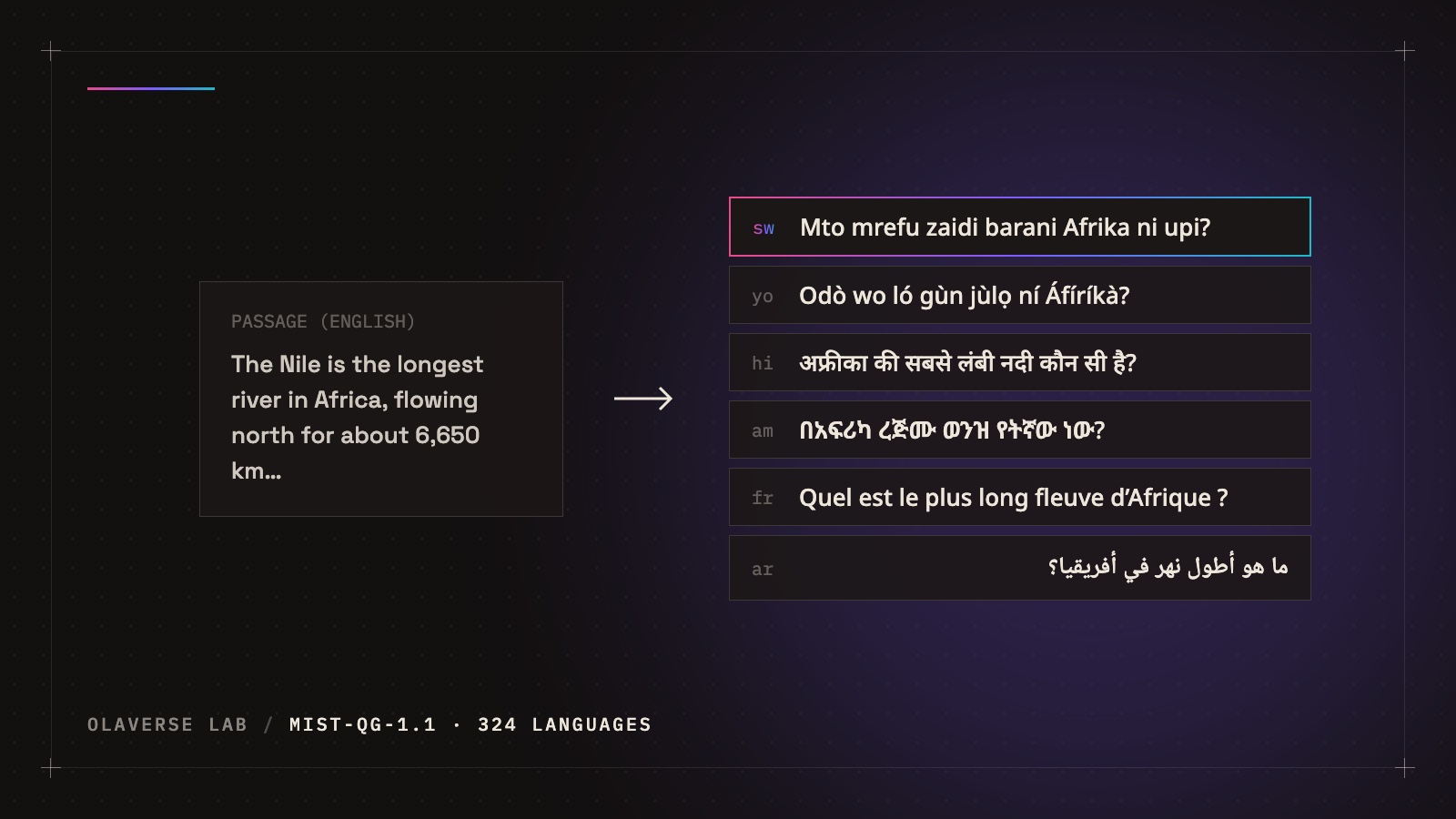
Today we're releasing MIST-QG, a question-generation model that turns any passage into the questions it answers, in 324 languages. It comes in two versions:
- MIST-QG-1.0 writes questions in the passage's own language, or in English or French.
- MIST-QG-1.1 adds two things. You can say how many questions you want, and it covers more cross-lingual directions.
Both are 4B models, released under Apache-2.0, and small enough to run on a single GPU. MIST-QG-1.1 is also on the Olaverse API, so you can call it without running anything yourself.
How it compares with bigger models
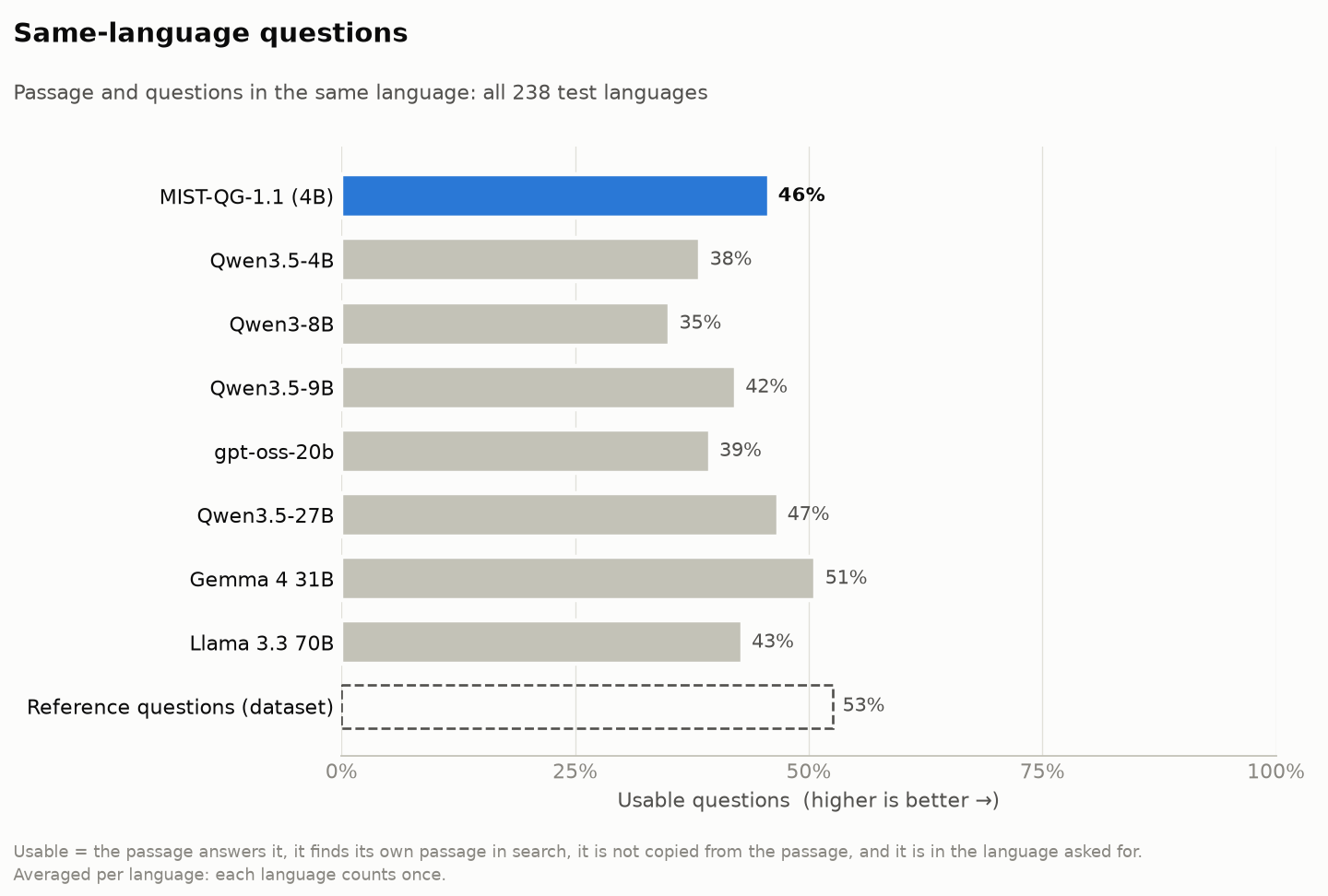
We tested MIST-QG against open models from 4B up to 70B. All of them saw the same held-out passages in 238 languages. A question counts as usable only if it passes four checks:
- the passage answers it;
- it finds its own passage in search;
- it isn't copied from the passage;
- it's in the language that was asked for.
Scores are averaged per language, so English counts the same as Yoruba or Quechua.
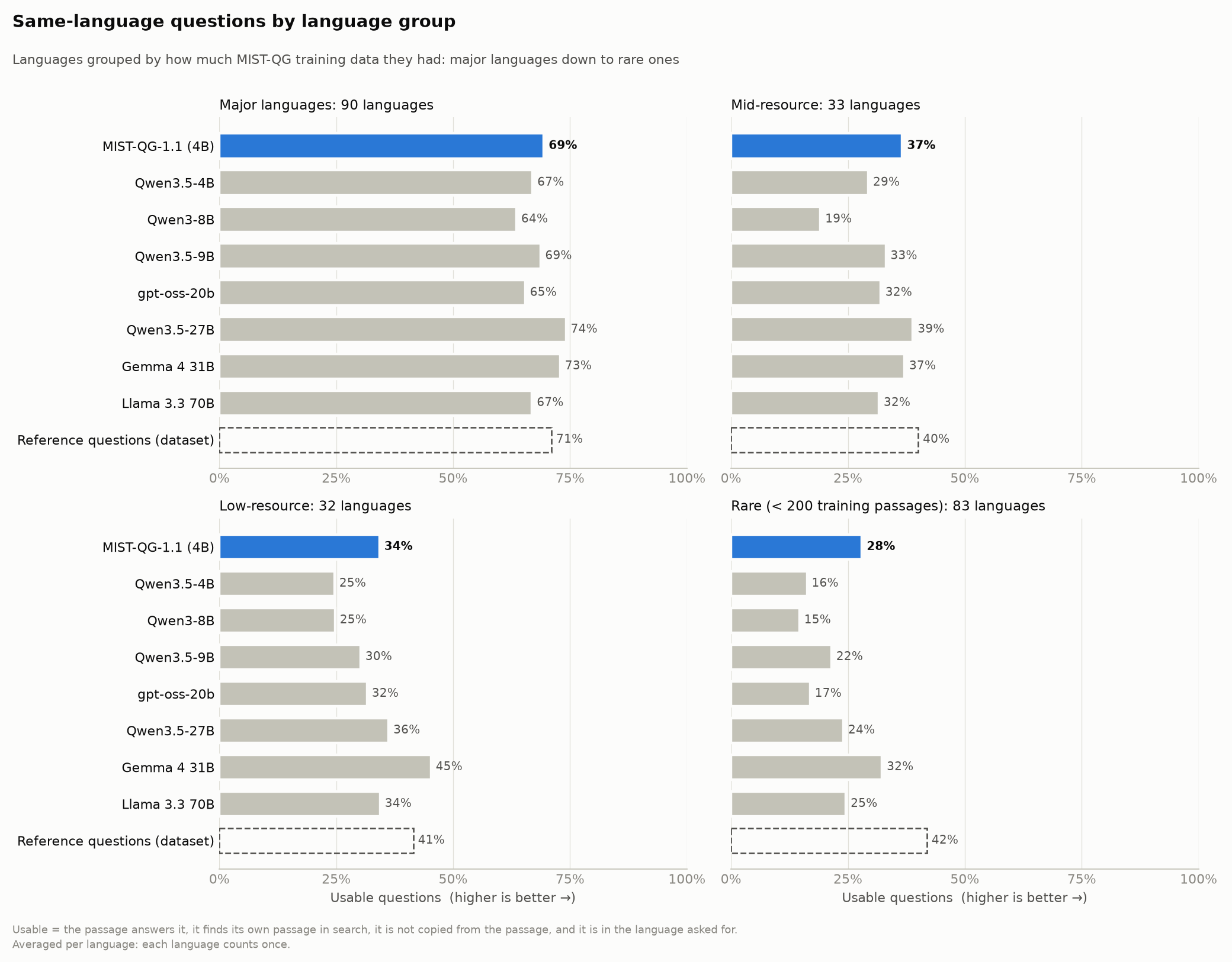
Same language. 46–47% of MIST-QG's questions are usable. That's on a par with Qwen3.5-27B and ahead of Llama 3.3 70B, Qwen3.5-9B and gpt-oss-20b. The one model that scores higher is Gemma 4 31B, nearly eight times its size, at 51%.
Rarest languages (under 200 training passages). 28–31% usable. Qwen, gpt-oss and Llama models up to 70B score 15–25%. Gemma 4 31B leads here too, at 32%, and on low-resource languages.
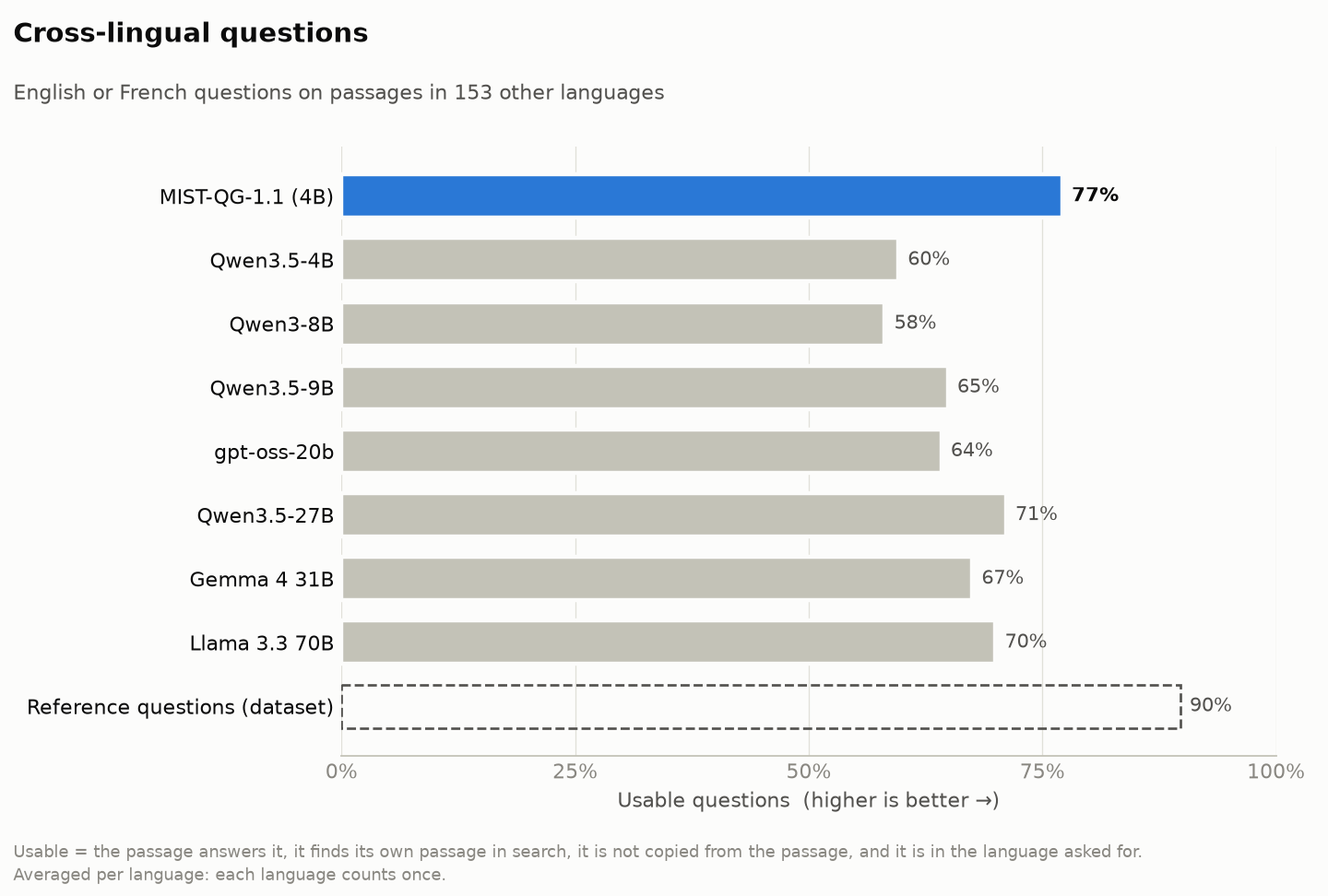
Cross-lingual (English or French questions on a passage in another language). 77–82% usable, the best of every model tested, Gemma 4 31B included (67%).
Finding its passage. Its questions find their own passage more often than any other model's questions do. That's the property that matters most when the pairs are used to train retrieval models.
What's new in 1.1
You choose the number of questions. Write "3 questions in Spanish that this passage answers…" and you get up to three.
- Cross-lingual: it returned exactly the number asked every time in our tests, from 1 to 5.
- Same language: it treats the number as a maximum. If a short passage only supports two good questions, you get two, not five padded ones.
More cross-lingual directions:
- A passage in any of the 324 languages → questions in English or French.
- An English or French passage → questions in any of 30 widely spoken languages, from Spanish, Hindi and Chinese to Swahili, Yoruba and Amharic.
- A passage in one of those 30 languages → questions in another of them.
Try it
On the Olaverse API. POST /v1/questions/generate runs MIST-QG-1.1. Set question_language for questions in another language, and n to a number from 1 to 5 or to "auto" to let the model decide how many. New accounts get $1 of free credit, and it's also on Azure Marketplace.
curl https://api.olaverselab.com/v1/questions/generate \
  -H "Authorization: Bearer $OLAVERSE_KEY" -H "Content-Type: application/json" \
  -d '{"passage": "The Nile is the longest river in Africa...", "question_language": "Swahili", "n": 3}'
Fields, limits and pricing are in the question generation docs. Get a key at console.olaverselab.com.
Self-hosted, with vLLM.
from vllm import LLM, SamplingParams

llm = LLM(model="olaverse/MIST-QG-1.1", max_model_len=4096)
prompt = ("Passage (English):\nThe Nile is the longest river in Africa...\n\n"
          "3 questions in Swahili that this passage answers, in your own words:\n")
out = llm.generate([prompt], SamplingParams(max_tokens=256, temperature=0.3, stop=["\n\n"]))
print(out[0].outputs[0].text)
GGUF versions for llama.cpp, Ollama and LM Studio are at olaverse/MIST-QG-1.1-GGUF. They're quantised with an importance matrix built from MIST-QG prompts across all its languages.
Part of the MIST family
MIST-QG is the data engine for the Olaverse MIST retrieval family, alongside MIST-Embed and MIST-Rerank. It turns raw text in any language into the training pairs that let search work well beyond English.
Models: MIST-QG-1.0 · MIST-QG-1.1 · MIST-QG-1.1-GGUF