Text-to-speech and voice
Tone marks decide pronunciation in Yorùbá and Vietnamese: restore them before speech synthesis.
People type without diacritics because phone keyboards make them slow, and old databases strip them. DiacNet restores Yorùbá tone marks, Vietnamese accents, Polish and Turkish letters and Arabic vowels, without rewriting your text.
$1 of free credit · open weights on Hugging Face
Yorùbá, Igbo, Hausa, Vietnamese, Polish, Turkish, Portuguese, Spanish, French, Italian and Arabic.
Alignment keeps every letter you typed and takes only the marks from the model.
Tell it which meaning you want for an ambiguous word: Vietnamese ambiguous-word accuracy rises from 0.63 to 0.90.
Full vowelling with case endings, or the lighter style most modern Arabic uses.
diactag-2.0 restores a typical sentence in about 8 ms on a laptop, and by design can never change a letter.
Run it on the API, or download it and process archives in your own environment.
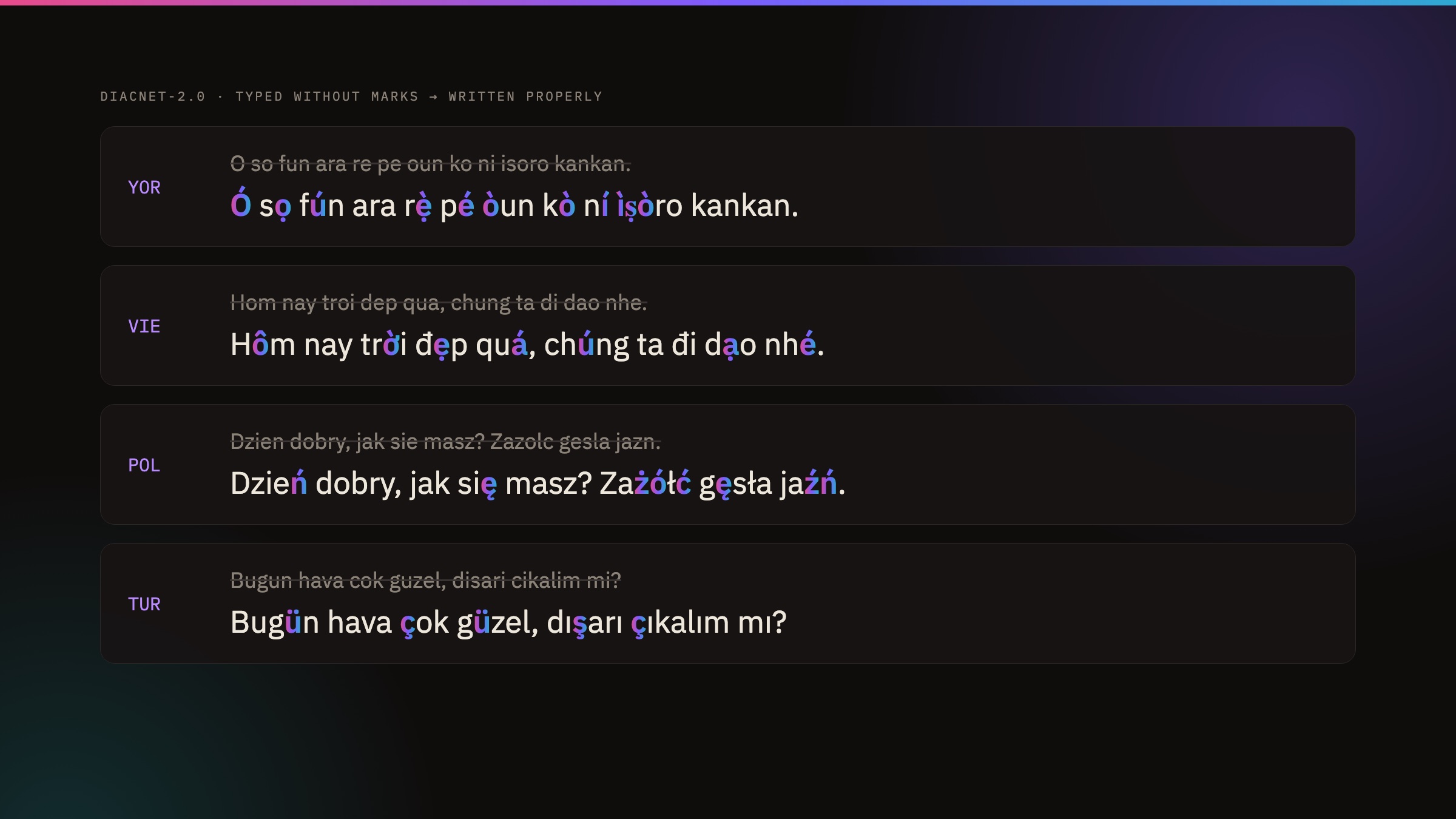
Pick a language. The output is exactly what diacnet-2.0 returned on our API; the restored marks are highlighted.
O so fun ara re pe oun ko ni isoro kankan.
Ó sọ fún ara rẹ̀ pé òun kò ní ìṣòro kankan.
Text typed without marks, as people do on phone keyboards.
Published results for diacnet-2.0.
Character-level error, lower is better. Shorter bar is better.
Accuracy on words whose marks depend on meaning.
Tone marks decide pronunciation in Yorùbá and Vietnamese: restore them before speech synthesis.
Restore marks in old databases and OCR output so search and display read properly.
Let people type quickly without marks and give them properly written text back.
DiacNet puts back the tone marks, accents and vowel marks that people leave out when they type: Yorùbá, Igbo, Vietnamese, Arabic and seven more. Missing marks change meaning, break search and make text-to-speech mispronounce, so restoring them matters in any sector that publishes, speaks or searches text in these languages.
Readers notice missing tone marks; editors don’t have time to add them by hand.
WatchRestoration is very good, not perfect: in Yorùbá about 7 characters in 100 can still be off, and only 12% of sentences come back exactly right. Have a fluent editor proofread anything published.
WatchFor teaching material, a teacher should check the output: learners copy what they see.
Where letters must never change, use diactag-2.0.
Put the accents and tone marks back, in 11 languages.
diacnet-2.0’s features at half the size.
Diacritics that can never change your letters.
| diacnet-2.0 → | diacnet-mini-2.0 → | diactag-2.0 → | |
|---|---|---|---|
| Parameters | 582M | 300M | 37.9M |
| How it works | Rewrites the text | Rewrites the text | Tags each character |
| Mean error rate, 10 languages | 0.0117 | 0.0141 | 0.0130 |
| Yorùbá error rate | 0.0698 | 0.0815 | 0.0787 |
| Strongest on | Yorùbá and European languages | Close to 2.0 at half the size | Igbo, Vietnamese, Modern Standard Arabic |
| Extras | Meaning hints, typo correction | Meaning hints, typo correction | CPU-ready ONNX, never alters letters |
Lowest error on 8 of 10 languages (mean DER 0.0117). Meaning hints and optional typo correction.
Same features at 300M, half the size, mean DER 0.0141.
Character tagger: compliance 1.0000 by construction. 38.6 MB int8 ONNX, about 8 ms a sentence on a laptop CPU. Strongest on Igbo, Vietnamese and Modern Standard Arabic.
The fastest start: an API key, pay as you go, $1 of free credit.
Download the model and run it on your own GPUs.
A private deployment, tuned to your data and workflows.
No. With alignment on (the default), every letter you typed is kept and only marks are added. diactag-2.0 goes further: it never predicts letters at all.
No. Leave the language as auto and it detects it, or set it when you know.
diacnet-2.0 for the best accuracy, diacnet-mini-2.0 for half the size, and diactag-2.0 when you need it on a CPU and a guarantee that letters never change.
No. Text is processed in memory, never logged and never used for training.