Train embedders and rerankers
Turn a raw corpus into (question, passage) pairs, in languages where no such data exists.
The (question, passage) pairs that embedders and rerankers learn from barely exist outside English. MIST-QG writes them from raw text in 324 languages, in the passage’s own language or across languages, small enough to run over millions of passages on one GPU.
$1 of free credit · open weights on Hugging Face
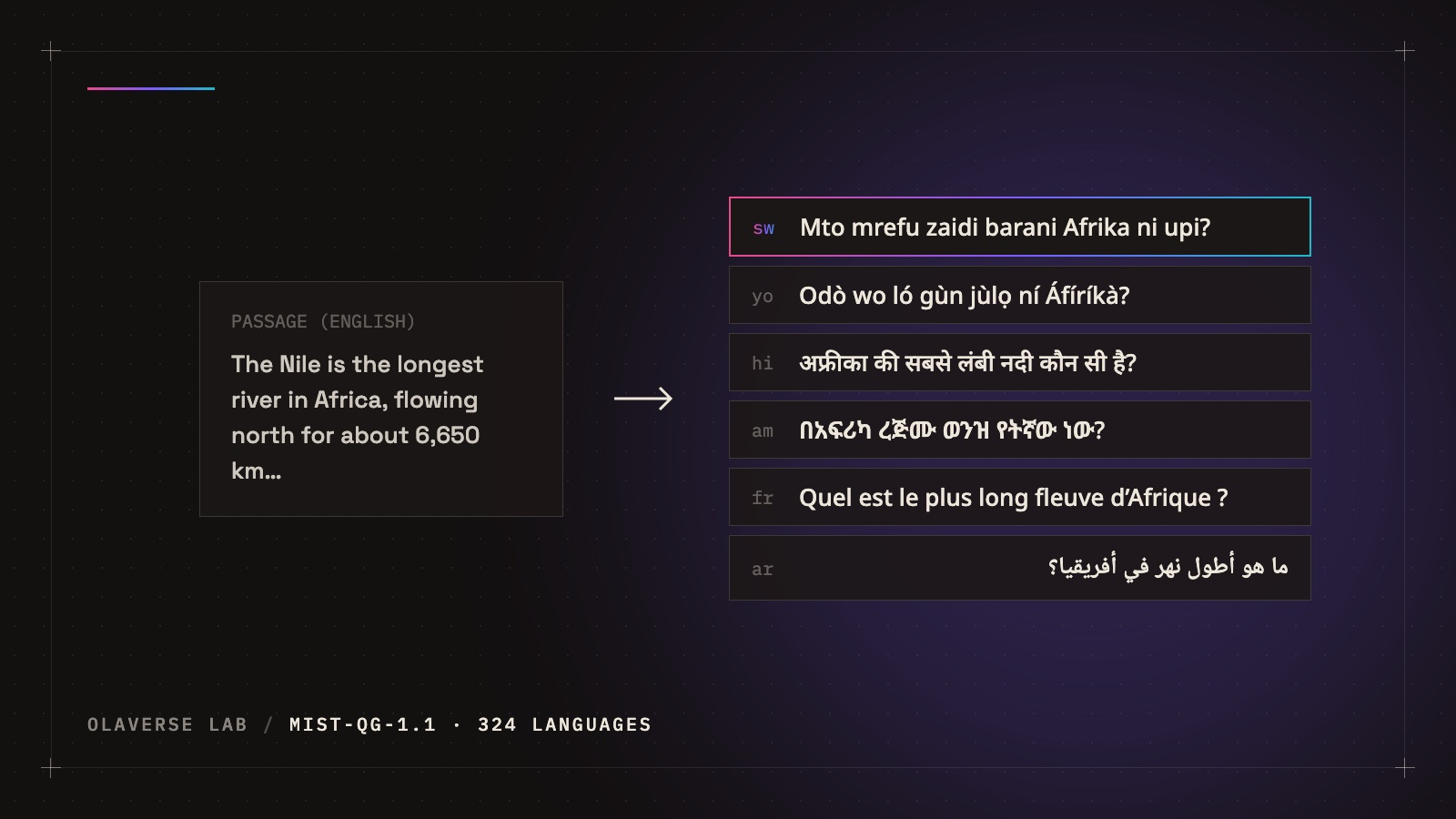
Trained on 324 languages, with low-resource and African languages deliberately well covered.
English or French questions on a passage in any language; with 1.1, also into and between 30 widely spoken languages.
Ask MIST-QG-1.1 for 1 to 5 questions; cross-lingually it returned exactly that many every time. Or let MIST-QG-1.0 decide from the passage.
Its questions find their own passage more often than any other model’s, which is what makes a good training pair.
Trained only on real questions: any that lifted a sentence from the passage were removed, so it asks rather than copies.
Apache-2.0, with GGUF builds for llama.cpp, Ollama and LM Studio. Your corpus never leaves your servers.
Pick a passage. The questions are real MIST-QG-1.1 outputs, in the passage’s own language or across languages.
The Nile is the longest river in Africa. It flows north for about 6,650 km through eleven countries before emptying into the Mediterranean Sea, and its waters have supported farming in Egypt for thousands of years.
{
 "questions": [
  "What is the longest river in Africa?",
  "How many countries does the Nile flow through?",
  "What sea does the Nile empty into?"
 ]
}
In the passage’s own language, the count you ask for is a maximum: the model writes only the questions the passage supports, so a short passage can give one. Across languages you get exactly the number asked.
Share of usable questions on held-out passages: the passage answers it, it finds its own passage, it isn’t copied, and it’s in the language asked for. Averaged per language, so each language counts once.
2,249 passages in 238 languages. On par with Qwen3.5-27B; only Gemma 4 31B, nearly eight times the size, scores higher.
English or French questions on 340 passages in 153 other languages. The best of every model tested, at about 1.75 questions per passage.
Given only the question, a retriever must rank its own passage first among all test passages in that language (R@1). What matters most for training pairs.
83 languages with fewer than 200 training passages each. Gemma 4 31B leads here.
Turn a raw corpus into (question, passage) pairs, in languages where no such data exists.
Pair English or French questions with passages in any language, so one query finds answers across languages.
Build test sets that check your search returns the right passage, language by language.
MIST-QG writes the questions a passage answers, in 324 languages. Its main job is the (question, passage) pairs that search and RAG systems learn from and are tested on, which barely exist outside English.
The clearest fit, because legal search lacks labelled query–passage data in most languages.
WatchPublic-defender research found that fine-tuning on existing legal benchmarks degraded performance, while curated synthetic data, legal domain adaptation and query expansion helped. Generated questions must resemble how real lawyers search, so seed them with real queries where possible.
WatchMIST-QG writes questions only: no answer keys or multiple-choice distractors, so pair it with other steps. Its "usable" rate measures retrieval-style questions, not teaching quality, so a teacher should approve every item.
WatchNever use it to produce clinical advice. It only generates evaluation or training data.
WatchLow-resource languages are both the opportunity and the risk, since quality is lowest there: 28% of questions are usable in the rarest languages.
Probably the lowest-risk first deployment: internal users, easy to measure, no one harmed by a bad question.
The questions a passage answers, in 324 languages, as many as you ask for.
Only the questions a passage really supports, in 324 languages.
Still available to download and run yourself. For new work, use the current lineup above.
| MIST-QG-1.1 → | MIST-QG-1.0 → | |
|---|---|---|
| Parameters | 4B | 4B |
| Passage languages | 324 | 324 |
| How many questions | You choose 1 to 5: exact every time cross-lingually | The passage decides |
| Question languages | Own language, English, French, and 30 more | Own language, English or French |
| English or French → 30 languages | 59% usable, 99.3% in the right language | Not supported |
| Between two of those 30 languages | 47% usable | Not supported |
| Cross-lingual questions per passage | About 1.75 | About 1 |
| Questions that find their own passage (R@1) | 0.701, the best tested | 0.696 |
| Best for | A set number of questions, in more languages and directions | Letting the passage decide how many |
| On the Olaverse API | Yes | No, self-host only |
324 languages, cross-lingual into English, French and 30 more, and you choose 1 to 5 questions. 77% of cross-lingual questions usable, the best of every model tested up to 70B.
The passage decides how many, so you only get the questions it supports: in its own language, English or French, across 324 languages.
The fastest start: an API key, pay as you go, $1 of free credit.
Download the model and run it on your own GPUs.
A private deployment, tuned to your data and workflows.
Start with 1.1: you choose how many questions, it writes into and between 30 widely spoken languages as well as English and French, and its questions find their own passage more often than any model tested. Use 1.0 when you would rather the passage decided how many.
Both models write in the passage’s own language, or in English or French, for passages in any of 324 languages. MIST-QG-1.1 also writes from English or French into 30 widely spoken languages, and between any two of them.
MIST-QG-1.1 is: POST /v1/questions/generate, with question_language for cross-lingual questions and n: "auto" to let the model decide how many. Both models are also open weights under Apache-2.0, to run with vLLM, Transformers or llama.cpp.
At 4B it runs comfortably on a single GPU with vLLM, so generating questions for millions of passages is practical. GGUF builds run on a laptop.